This study not only investigates the various aspects of the magnificent nāga motif in Khmer art, but also it
- confirms, by means of expanding upon the development of the nāga fan (Chapter 3) the – recently again challenged – sequence of main monuments in Angkor , namely the Angkor Wat erected under Suryvarman II (1113–1150 AD), and the Bayon erected under Jayavarman VII (1181–1219 AD)
- clarifies the identity of several regents of the directions of space (Chapters 1 and 9) in Khmer art and discovers the 10th regent Śeṣa / Ananta in the Great Gallery of Angkor Wat (Chapter 9)
- tries to elaborate a clear distinction between akroteria and antefixes in order to to give some system to a significantly diverging terminology on the part of scholars (Chapter 5)
- replaces, last but not least, the so called Tārakāmaya war (saṃgrāma) as the narrative background to one of the most beautiful panels of the Great Gallery of Angkor Wat with a new and, I hope, more fitting explanation (Chapter 9).
Traces of serpent worship can be found all over the Indian subcontinent, either directly or mirrored by other Indian religions. While in India the nāga motif may rightly be called a fertile motif in the religious arts, in the Khmer empire it is of extraordinary, unsurpassed importance and allows the conclusion that both religions, Hinduism and Buddhism, when reaching Cambodia encountered an atmosphere where any nāga myth and nāga décor in the arts was more than welcome.
Whether Nāga tribe in Assam – in the event that their name has anything at all to do with serpents = nāgas – can be taken, in the past or now, as bearers of nāga worship must, at the moment, be cautiously denied. To give only two important sources: J. Ph. Vogel, who carefully collected an enormous mass of testimonies on serpent worship in India (Indian Serpent Lore, London 1926), does not give any hint of this possibility, and Fürer-Haimendorf, who spent thirteen months with the Assamese Nāgas (Die nackten Nagas, Leipzig 1947), evidently did not observe any particular serpent cult among these people. Milada Ganguli (A Pilgrimage to the Nagas. New Delhi 1984) does not give any hint at nāga worship among the Nāgas of the Indo-Burmese borderlands either.
Julia Shaw, however, observes a relation between a local Nāga clan and nāga sculptures as agricultural deities in the Sāñcī area, Madhyapradesh.
As with the cult of spirits (bhūta, yakṣa) nāga worship seems to have remained prevalent in India as a basic religion of the common people that was never entirely displaced by the so called high religions such as Buddhism and Hinduism but preserved an important role in popular belief and imbued the imagination of the people.
It should be kept in mind that the supreme gods such as Śiva, Viṣṇu, and Devī are worshipped in order to ensure the salvation (mokṣa) of their believers. The minor gods are propitiated for practical purposes: in order to avoid their malevolent actions and to secure their benevolent behaviour. In the case of the nāgas it is above all protection against drought or arrival of rain that is sought.
The main features that seem to be responsible for the widespread relevance of serpents in Indian thinking have been impressively collected by J.Ph. Vogel.
“If we wish to explain serpent worship, we must start from the animal itself. Which among a primitive population is so suitable to be regarded as a demonic being endowed with magical power? The snake is unlike other animals, owing to its peculiar shape and its swift and mysterious gliding motion without the aid of either feet or wings. In addition to these most conspicuous properties the snake possesses other strange features such as the power of fascination of its eye, its forked tongue (of which the Mahābhārata offers a mythical explanation), and the periodical sloughing of its skin which is referred to in Vedic literature. The serpent is, indeed, the uncanniest of all animals. Above all things it is the deadly poison of certain snakes that causes the whole species to be looked upon as demoniacal beings which are to be dreaded and to be propitiated. There is an Indian proverb which says: ‘Even a great man is not worshipped, as long as he has not caused some calamity: men worship the Nāgas, but not Garuḍa, the slayer of Nāgas.’” (Otto von Böthlink, Indische Sprüche. 2nd ed. 1870, vol. 1, p. 7, No. 39).
Particularly narrow is the affiliation of the nāgas to early and later Buddhism (see also Zin 2003, pp. 121–130).
Although the Buddha himself was three times born as a nāga – i.e. Campaka, Śaṅkhapāla, and Bhūridatta (Vogel 1926, p. 133) – animals including nāgas who are able to adopt human shape are a priori excluded from ordination.
The nāgas appear as fervent worshippers of the Buddha and of the stūpas on the one hand, as faithful guardians of Buddhist sanctuaries on the other hand. The report on the distribution of the relics is not free from contradictions. One of the eight shares of the relics has been, according to unanimous tradition, obtained by a kṣatriya clan (Krauḍyas or Koliyas). Another passage, however, says that the eighth part of the relics was left in the hands of the nāgas in Rāmagrāma (Waldschmidt 1948, p. 330f. and Waldschmidt 1950, p. 450).
The Mahāvaṃsa, on the other hand, reports that the stūpa of Rāmagrāma was destroyed by the floods of the Ganga (Mahāvaṃsa XXXI, 25; Geiger 1958, p. 247, Geiger 264, p. 211), the reliquary floated to the mouth of the river and was then worshipped by the nāgas in nāgaloka – i.e. beneath the surface of the human world –, and finally came into Duṭṭhagāmaṇī’s newly built great stūpa (Mahāthūpa) on the island of Laṅkā (Laṅkādīpe) (Mahāvaṃsa XXXI,19; Geiger 1958, p. 246, Geiger 1964, p. 210). This report superbly connects Singhalese Buddhism with the earliest Buddhism comparable to the tradition that Anuradhapura’s bodhi tree goes back to an offshoot of the original bodhi tree.
….
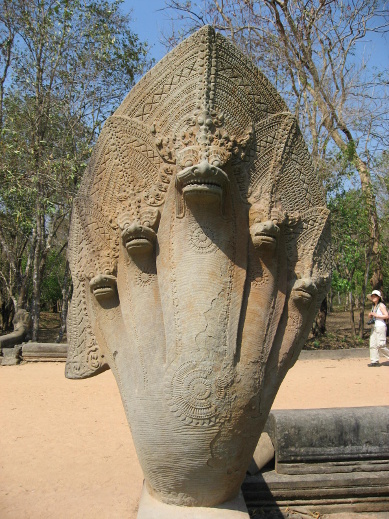
Fig. 56. Nāga fan, Beng Mealea, south access, eastside.
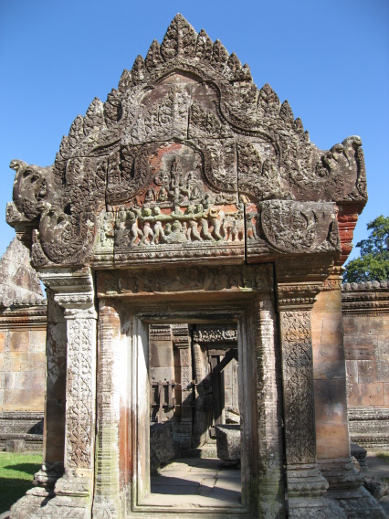
Fig. 64. Fronton with amr̥tamanthana and lintel with Anantaśayana, Prasat Preah Vihear, gopura IV, southside.
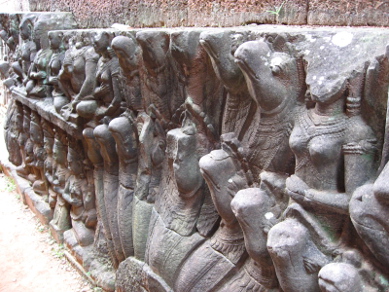
Fig. 122. Fourteen-hooded nāga, Terrace of Leper King, corridor.


 Pandanus Publikace